National Geographic the Human Family Tree Worksheet Answers
Man naledi
Fossil Trove Adds a New Limb to Man Family Tree
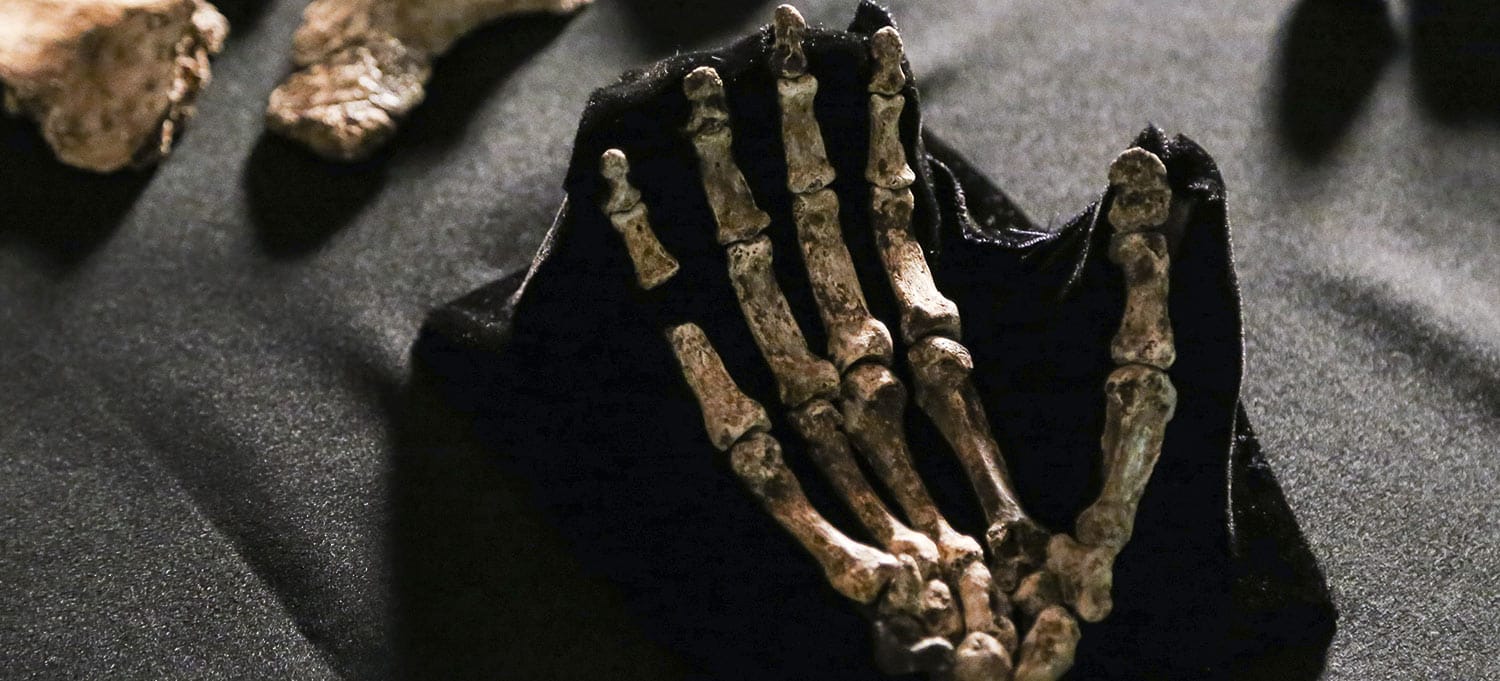
Skeletal fossil of the hand of Homo naledi. Photo: John Hawks, UW–Madison
"We accept a new species of Homo, with all of its interesting characteristics. Nosotros now take the biggest discovery in Africa for hominins."

John Hawks, University of Wisconsin paleoanthropologist
Working in a cavern complex deep beneath Due south Africa'south Malmani dolomites, an international squad of scientists has brought to light an unprecedented trove of hominin fossils — more than than 1,500 well-preserved bones and teeth — representing the largest, most complete set of such remains found to date in Africa.
The discovery of the fossils, cached in a barely attainable chamber in a subterranean labyrinth non far from Johannesburg, adds a new co-operative to the human family tree, a creature dubbed Human naledi.
The remains, scientists believe, could only have been deliberately interred.
So far, parts of at to the lowest degree 15 skeletons representing individuals of all ages have been found and the researchers believe many more fossils remain in the chamber. It is part of a complex of limestone caves near what is called "The Cradle of Humankind," a World Heritage Site in Gauteng province well known for critical paleoanthropological discoveries of early humans, including the 1947 discovery of two.three million-yr-old Australopithecus africanus.
"We have a new species of Human, with all of its interesting characteristics," says John Hawks, a University of Wisconsin-Madison paleoanthropologist and one of the leaders of a squad that painstakingly retrieved the fossils under excruciatingly cramped and difficult conditions. "Nosotros now have the biggest discovery in Africa for hominins."
The find was reported today (Sept. 10, 2015) with the publication of two papers in the open access journal eLife by a group led by paleoanthropologist Lee R. Berger of the Academy of Witwatersrand.
With a modest caput and brain, hunched shoulders, powerful hands and sparse limbs, Homo naledi was built for long-distance walking, says Hawks, an expert on early humans. Fully grown, it stood about v feet tall, was broad chested, walked upright and had a face, including a smile that was probably more than human than apelike. Powerful hands imply it was as well a climber.
The fossils accept yet to be dated. The unmineralized condition of the bones and the geology of the cavern take prevented an accurate dating, says Hawks. "They could accept been there ii one thousand thousand years ago or 100,000 years ago, peradventure coexisting with modern humans. We don't yet have a date, merely nosotros're attempting it in every style we can."
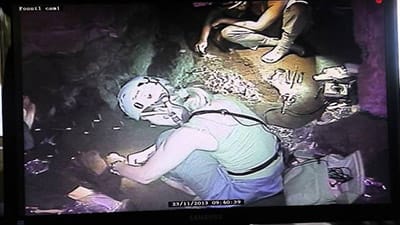
And so far, the remains of newborns to the anile have been exhumed from the cave and the researchers expect that many more basic remain in the chamber, which is most 100 feet undercover and attainable but after squeezing, clambering and crawling 600 feet to a large chamber where the breakable fossils cover the floor.
"We know well-nigh every role of the beefcake, and they are not at all like humans," notes Hawks, who co-directed the assay of the fossils. "We couldn't friction match them to anything that exists. Information technology is clearly a new species."
The astonishing find was made initially by apprentice cavers and thought at the time to be a single hominin skeleton. The fossils were retrieved past a band of diminutive paleoanthropologists, all women, recruited for their size.
"Naledi" means star in the Sesotho language and is a reference to the Rise Star cave arrangement that includes the chamber, known as the Dinaledi Chamber, where the fossils were plant. The complex and difficult passage to the sleeping accommodation narrows at 1 point to a bare seven inches.
Homo naledi's: A new species
In improver to identifying an entirely new species in the genus Homo, the collections of fossils, which acquit no marks from predators or scavengers, are strong prove that Homo naledi was deliberately interring its expressionless, according to Hawks, a UW-Madison professor of anthropology.
"We think it is the first example of deliberate and ritualized interment," says Hawks. "The only plausible scenario is they deliberately put bodies in this place."
The cave, co-ordinate to Hawks, was likely more accessible to Man naledi than it is today for modern humans. Geochemical tests, all the same, bear witness that the cavern was never open to the surface, raising intriguing questions near the beliefs and technologies available to the creatures.
"We know it was not a death trap," says Hawks, referring to natural features like hidden sinkholes that sometimes trap and doom creatures over long periods of fourth dimension. "There are no bones from other animals aside from a few rodents. And there are no marks on the bones from predators or scavengers to suggest they were killed and dragged to the sleeping room. We tin as well rule out that information technology was a sudden mass decease."
Instead, Hawks, Berger and their colleagues believe the chamber was something like a repository. "Information technology seems probable that a group of hominins was returning to this place over a period of time and depositing bodies," Hawks explains, adding that the supposition that Human naledi was interring its expressionless is akin to discovering similar behavior in chimpanzees. "It would be that surprising."
The way the bodies are arranged and their completeness suggests they were carried to the cave intact. "The bodies were non intentionally covered and we're not talking about a religious anniversary, only something that was repeated and repeated in the same place. They clearly learned to do this and did it every bit a group over time. That'due south cultural. Only humans and close relatives like Neandertals do annihilation like this."
Homo naledi: a unique gathering
So far, no other organic materials or evidence of burn have been found in the cave complex.
Dating the fossils remains a central problem to solve, says Hawks. "We depend on the geology to help the states date things, and hither the geology isn't much like other caves in S Africa. And the fossils don't take annihilation within them that we tin can date. It's a problem for us."
One hope, he says, is finding the remains of an brute that may have been a contemporary of Man naledi. The fossils are embedded in a matrix of soft sediment and at that place are layers that remain unexcavated.
"It seems probable that a group of hominins was returning to this place over a menstruum of time and depositing bodies."
John Hawks, UW–Madison
Co-ordinate to Hawks, years of piece of work remain at the site and to document and analyze all of the materials excavated from the Dinaledi Chamber. Plans, he says, include bringing many new technologies to impact analyzing the fossils to help determine diet, rate of aging and where on the landscape the creatures may take been from.
The projection to excavate the fossils was supported by the National Geographic Social club, the S African National Research Foundation, the Gauteng Provincial Government. The Wisconsin Alumni Enquiry Foundation likewise provided support, as did the Texas A&M Higher of Liberal Arts Seed Grant Programme.
Source: https://news.wisc.edu/naledi/
0 Response to "National Geographic the Human Family Tree Worksheet Answers"
Post a Comment