Shoots Burglar 5 Years Ago and Again Recently
John Dillinger
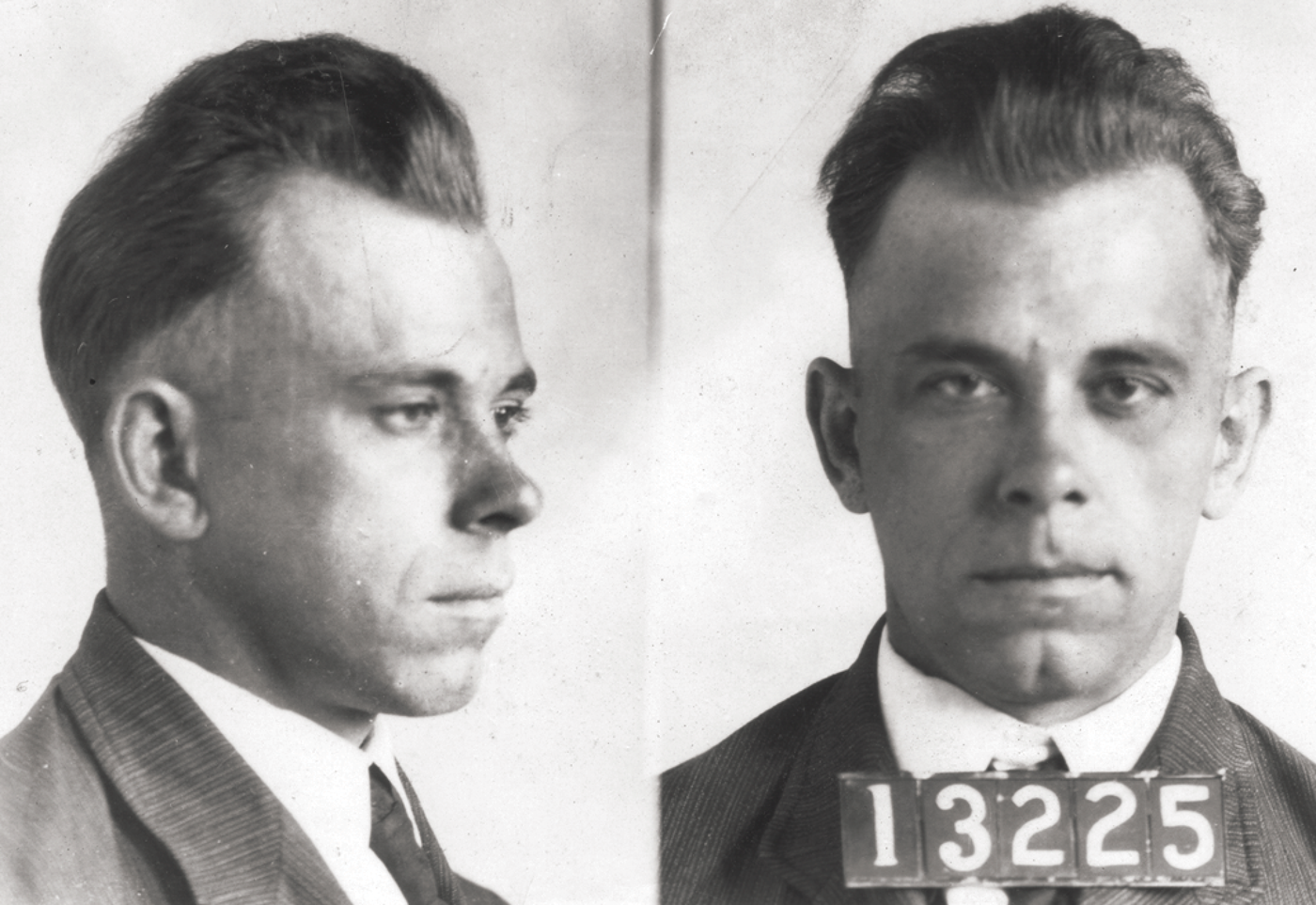
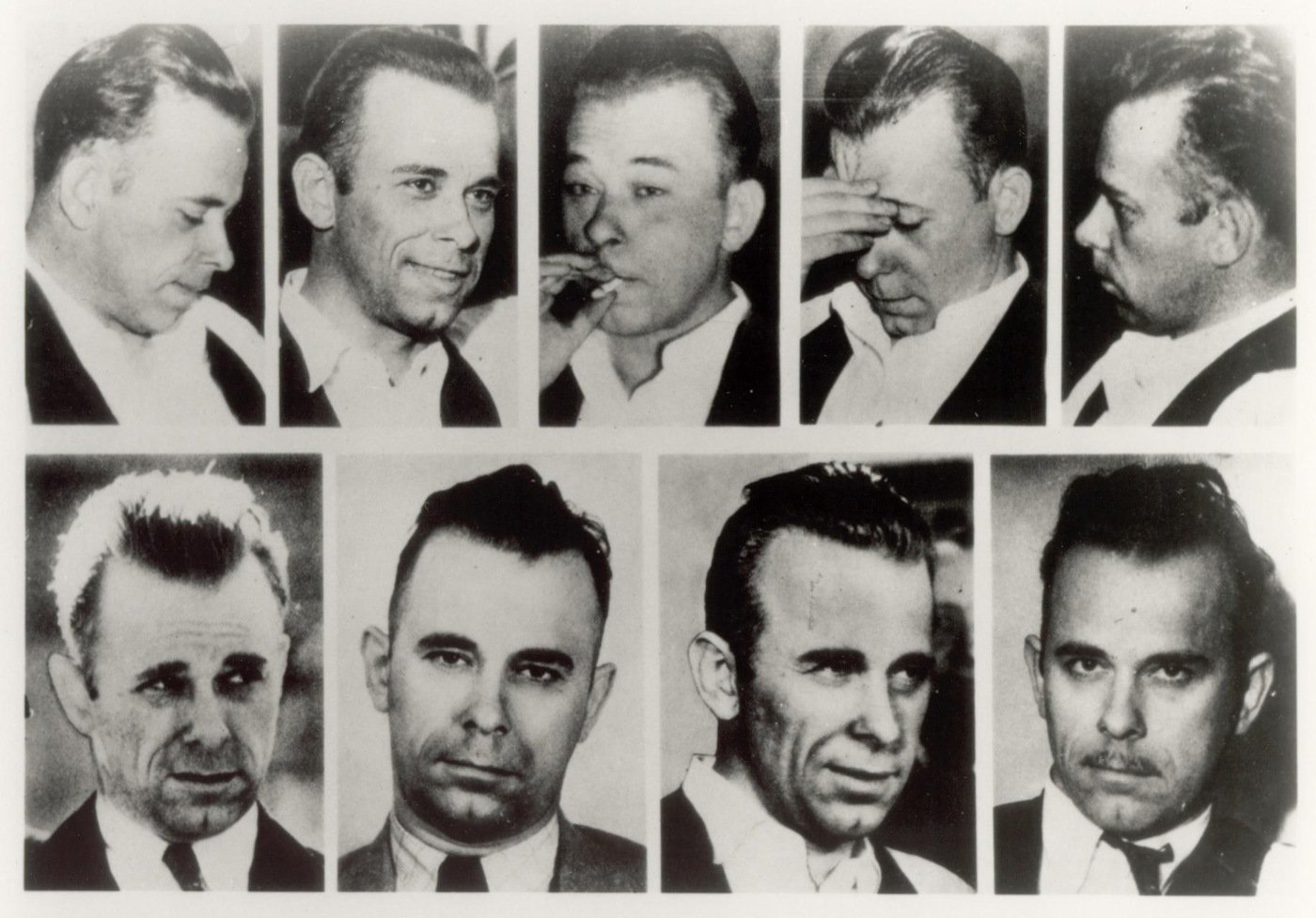
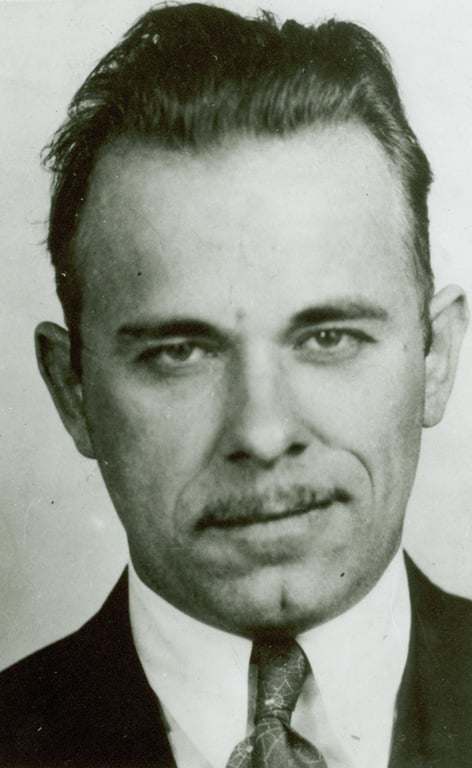
During the 1930s Low, many Americans, most helpless against forces they didn't sympathize, made heroes of outlaws who took what they wanted at gunpoint. Of all the pulp desperadoes, one homo, John Herbert Dillinger, came to evoke this Gangster Era and stirred mass emotion to a degree rarely seen in this country.
Dillinger, whose proper noun one time dominated the headlines, was a notorious and barbarous thief. From September 1933 until July 1934, he and his violent gang terrorized the Midwest, killing 10 men, wounding 7 others, robbing banks and police arsenals, and staging 3 jail breaks—killing a sheriff during one and wounding 2 guards in some other.
John Herbert Dillinger was born on June 22, 1903 in the Oak Hill section of Indianapolis, a center-class residential neighborhood. His male parent, a hardworking grocer, raised him in an atmosphere of disciplinary extremes, harsh and repressive on some occasions, but generous and permissive on others. John's mother died when he was 3, and when his father remarried 6 years afterwards, John resented his stepmother.
In adolescence, the flaws in his bewildering personality became evident, and he was oftentimes in trouble. Finally, he quit school and got a chore in a machine store in Indianapolis. Although intelligent and a good worker, he shortly became bored and often stayed out all night. His father, worried that the temptations of the city were corrupting his teenage son, sold his property in Indianapolis and moved his family to a farm almost Mooresville, Indiana. However, John reacted no better to rural life than he had to that in the city and soon began to run wild again.
A break with his male parent and trouble with the law (auto theft) led him to enlist in the Navy. In that location he soon got into trouble and deserted his ship when information technology docked in Boston. Returning to Mooresville, he married 16-year-old Beryl Hovius in 1924. A dazzling dream of bright lights and excitement led the newlyweds to Indianapolis. Dillinger had no luck finding work in the urban center and joined the town pool shark, Ed Singleton, in his search for piece of cake coin. In their first attempt, they tried to rob a Mooresville grocer, but were apace apprehended. Singleton pleaded not guilty, stood trial, and was sentenced to 2 years in prison. Dillinger, post-obit his father'southward advice, confessed, was convicted of assault and battery with intent to rob and conspiracy to commit a felony, and received joint sentences of two to 14 years and 10 to 20 years in the Indiana Country Prison. Stunned by the harsh judgement, Dillinger became a tortured, bitter man in prison.
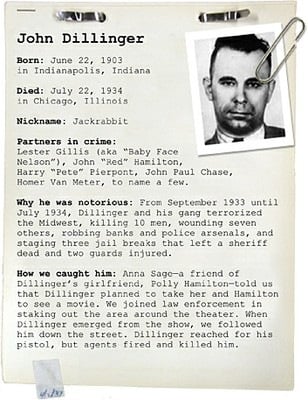 His menses of infamy began on May 10, 1933, when he was paroled from prison later on serving eight-and-a-one-half years of his sentence. Almost immediately, Dillinger robbed a banking concern in Bluffton, Ohio. Dayton police arrested him on September 22, and he was lodged in the county jail in Lima, Ohio to look trial.
In frisking Dillinger, the Lima constabulary plant a document which seemed to exist a programme for a prison interruption, merely the prisoner denied knowledge of any plan. Iv days later, using the same plans, 8 of Dillinger'southward friends escaped from the Indiana State Prison house, using shotguns and rifles that had been smuggled into their cells. During their escape, they shot two guards.
On October 12, iii of the escaped prisoners and a parolee from the same prison showed up at the Lima jail where Dillinger was incarcerated. They told the sheriff that they had come up to return Dillinger to the Indiana State Prison for violation of his parole.
When the sheriff asked to encounter their credentials, one of the men pulled a gun, shot the sheriff, and beat him into unconsciousness. Then taking the keys to the jail, the bandits freed Dillinger, locked the sheriff'south wife and a deputy in a prison cell, and leaving the sheriff to dice on the floor, fabricated their getaway.
Although none of these men had violated a federal constabulary, the FBI's assist was requested in identifying and locating the criminals. The four men were identified as Harry Pierpont, Russell Clark, Charles Makley, and Harry Copeland. Their fingerprint cards in the FBI Identification Segmentation were flagged with cherry metallic tags, indicating that they were wanted.
Meanwhile, Dillinger and his gang pulled several bank robberies. They also plundered the police arsenals at Auburn, Indiana and Peru, Indiana, stealing several automobile guns, rifles, and revolvers, a quantity of ammunition, and several bulletproof vests. On December 14, John Hamilton, a Dillinger gang member, shot and killed a police detective in Chicago. A month later on, the Dillinger gang killed a police officer during the robbery of the First National Bank of E Chicago, Indiana. Then they made their manner to Florida and, subsequently, to Tucson, Arizona. There on January 23, 1934, a fire broke out in the hotel where Clark and Makley were hiding under causeless names. Firemen recognized the men from their photographs, and local police force arrested them, equally well as Dillinger and Harry Pierpont. They also seized three Thompson submachine guns, two Winchester rifles mounted equally car guns, five bulletproof vests, and more $25,000 in greenbacks, part of it from the East Chicago robbery.
Dillinger was sequestered at the county jail in Crown Point, Indiana to await trial for the murder of the East Chicago police force officeholder. Authorities boasted that the jail was "escape proof." But on March three, 1934, Dillinger cowed the guards with what he claimed later was a wooden gun he had whittled. He forced them to open the door to his prison cell, then grabbed two motorcar guns, locked up the guards and several trustees, and fled.
It was then that Dillinger fabricated the fault that would cost him his life. He stole the sheriff'southward car and drove across the Indiana-Illinois line, heading for Chicago. By doing that, he violated the National Motor Vehicle Theft Act, which fabricated it a federal offense to ship a stolen motor vehicle across a land line.
A federal complaint was sworn charging Dillinger with the theft and interstate transportation of the sheriff's automobile, which was recovered in Chicago. After the one thousand jury returned an indictment, the FBI became actively involved in the nationwide search for Dillinger.
Meanwhile, Pierpont, Makley, and Clark were returned to Ohio and bedevilled of the murder of the Lima sheriff. Pierpont and Makley were sentenced to death and Clark to life imprisonment. But in an escape attempt, Makley was killed, and Pierpont was wounded. A calendar month later, Pierpont had recovered sufficiently to be executed.
In Chicago, Dillinger joined his girlfriend, Evelyn Frechette. They proceeded to St. Paul, where Dillinger teamed up with Homer Van Meter, Lester ("Baby Face Nelson") Gillis, Eddie Green, and Tommy Carroll, among others. The gang'south business prospered as they continued robbing banks of large amounts of money.
Then on March 30, 1934, an agent talked to the director of the Lincoln Court Apartments in St. Paul, who reported two suspicious tenants, Mr. and Mrs. Hellman, who acted nervous and refused to acknowledge the apartment caretaker. The FBI began a surveillance of the Hellman'south apartment. The next day, an agent and a police force officeholder knocked on the door of the apartment. Evelyn Frechette opened the door, but quickly slammed it shut. The agent chosen for reinforcements to surround the building.
While waiting, the agents saw a human enter a hall near the Hellman'southward apartment. When questioned, the man, Homer Van Meter, drew a gun. Shots were exchanged, during which Van Meter fled the building and forced a truck commuter at gunpoint to drive him to Green's apartment. Suddenly the door of the Hellman flat opened and the cage of a automobile gun began spraying the hallway with pb. Under embrace of the motorcar gun fire, Dillinger and Evelyn Frechette fled through a dorsum door. They, too, drove to Green'due south apartment, where Dillinger was treated for a bullet wound received in the escape.
At the Lincoln Court Apartments, the FBI found a Thompson submachine gun with the stock removed, two automatic rifles, 1 .38 quotient Filly automatic with twenty-shot magazine clips, and two bulletproof vests. Across boondocks, other agents located one of Eddie Light-green's hideouts where he and Bessie Skinner had been living as "Mr. and Mrs. Stephens." On April 3, when Green was located, he attempted to draw his gun, but was shot by the agents. He died in a hospital viii days later.
Dillinger and Evelyn Frechette fled to Mooresville, Indiana, where they stayed with his male parent and half-brother until his wound healed. Then Frechette went to Chicago to visit a friend—and was arrested by the FBI. She was taken to St. Paul for trial on a charge of conspiracy to harbor a fugitive. She was convicted, fined $ane,000, and sentenced to 2 years in prison. Bessie Skinner, Eddie Light-green's girlfriend, got 15 months on the same charge.
Meanwhile, Dillinger and Van Meter robbed a police force station at Warsaw, Indiana of guns and bulletproof vests. Dillinger stayed for awhile in Upper Michigan, departing just ahead of a posse of FBI agents dispatched there by airplane. And so the FBI received a tip that there had been a sudden influx of rather suspicious guests at the summer resort of Piffling Bohemia Lodge, nearly fifty miles north of Rhinelander, Wisconsin. One of them sounded like John Dillinger and another like Baby Face Nelson.
From Rhinelander, an FBI job force set up out by machine for Little Bohemia. 2 of the rented cars broke downwards enroute, and, in the uncommonly cold April weather condition, some of the agents had to brand the trip standing on the running boards of the other cars. Two miles from the resort, the automobile lights were turned off and the posse proceeded through the darkness. When the cars reached the resort, dogs began barking. The agents spread out to environment the lodge and equally they approached, machine gun fire rattled down on them from the roof. Swiftly, the agents took cover. One of them hurried to a telephone to give directions to additional agents who had arrived in Rhinelander to back upwardly the operation.
While the amanuensis was telephoning, the operator bankrupt in to tell him there was trouble at some other cottage about two miles away. Special Agent Due west. Carter Baum, another FBI human, and a constable went in that location and found a parked car which the lawman recognized as belonging to a local resident. They pulled upwardly and identified themselves.
Inside the other automobile, Babe Confront Nelson was property three local residents at gunpoint. He turned, leveled a revolver at the lawmen's car and ordered them to stride out. But without waiting for them to comply, Nelson opened fire. Baum was killed, and the constable and the other agent were severely wounded. Nelson jumped into the Ford they had been using and fled.
When the firing had subsided at the Footling Bohemia Lodge, Dillinger was gone. When the agents entered the lodge the next morning, they found only 3 frightened females. Dillinger and five others had fled through a back window before the agents surrounded the house.
 In Washington, FBI Director J. Edgar Hoover assigned Special Agent Samuel A. Cowley to caput the FBI's investigative efforts against Dillinger. Cowley ready headquarters in Chicago, where he and Melvin Purvis, special amanuensis in charge of the Chicago role, planned their strategy. A squad of agents under Cowley worked with East Chicago policemen in tracking downward all tips and rumors.
Late in the afternoon of Saturday, July 21, 1934, the madam of a brothel in Gary, Indiana, contacted 1 of the law officers with data. This woman called herself Anna Sage; however, her real name was Ana Cumpanas, and she had entered the The states from her native Rumania in 1914. Considering of the nature of her profession, she was considered an undesirable alien by the Immigration and Naturalization Service, and deportation proceedings had been started. Anna was willing to sell the FBI some data about Dillinger for a cash advantage, plus the FBI's aid in preventing her deportation.
At a meeting with Anna, Cowley and Purvis were cautious. They promised her the reward if her information led to Dillinger's capture, simply said all they could do was call her cooperation to the attention of the Department of Labor, which at that time handled displacement matters. Satisfied, Anna told the agents that a girlfriend of hers, Polly Hamilton, had visited her establishment with Dillinger. Anna had recognized Dillinger from a newspaper photograph.
Anna told the agents that she, Polly Hamilton, and Dillinger probably would be going to the movies the following evening at either the Biograph or the Marbro Theaters. She said that she would notify them when the theater was chosen. She too said that she would clothing an orange dress then that they could identify her.
On Sunday, July 22, Cowley ordered all agents of the Chicago office to stand up past for urgent duty. Anna Sage called that evening to ostend the plans, but she still did non know which theater they would nourish. Therefore, agents and policemen were sent to both theaters. At 8:30 p.thou., Anna Sage, John Dillinger, and Polly Hamilton strolled into the Biograph Theater to run across Clark Gable in "Manhattan Melodrama." Purvis phoned Cowley, who shifted the other men from the Marbro to the Biograph.
Cowley also phoned Hoover for instructions. Hoover cautioned them to await outside rather than adventure a shooting friction match within the crowded theater. Each man was instructed non to unnecessarily endanger himself and was told that if Dillinger offered any resistance, it would be each man for himself.
At 10:30 p.thousand., Dillinger, with his 2 female companions on either side, walked out of the theater and turned to his left. As they walked by the doorway in which Purvis was standing, Purvis lit a cigar as a signal for the other men to close in.
Dillinger chop-chop realized what was happening and acted by instinct. He grabbed a pistol from his right trouser pocket every bit he ran toward the alley. 5 shots were fired from the guns of three FBI agents. 3 of the shots striking Dillinger, and he roughshod face down on the pavement. At 10:l p.m. on July 22, 1934, John Dillinger was pronounced dead in a little room in the Alexian Brothers Hospital.
The agents who fired at Dillinger were Charles B. Winstead, Clarence O. Hurt, and Herman E. Hollis. Each human was commended past J. Edgar Hoover for fearlessness and courageous action. None of them ever said who actually killed Dillinger. The events of that sultry July night in Chicago marked the beginning of the end of the Gangster Era. Eventually, 27 persons were convicted in federal courts on charges of harboring and aiding and abetting John Dillinger and his cronies during their reign of terror. Baby Face up Nelson was fatally wounded on Nov 27, 1934, in a gun battle with FBI agents in which Special Agents Cowley and Hollis also were killed. Dillinger was buried in Crown Hill Cemetery in Indianapolis, Indiana.
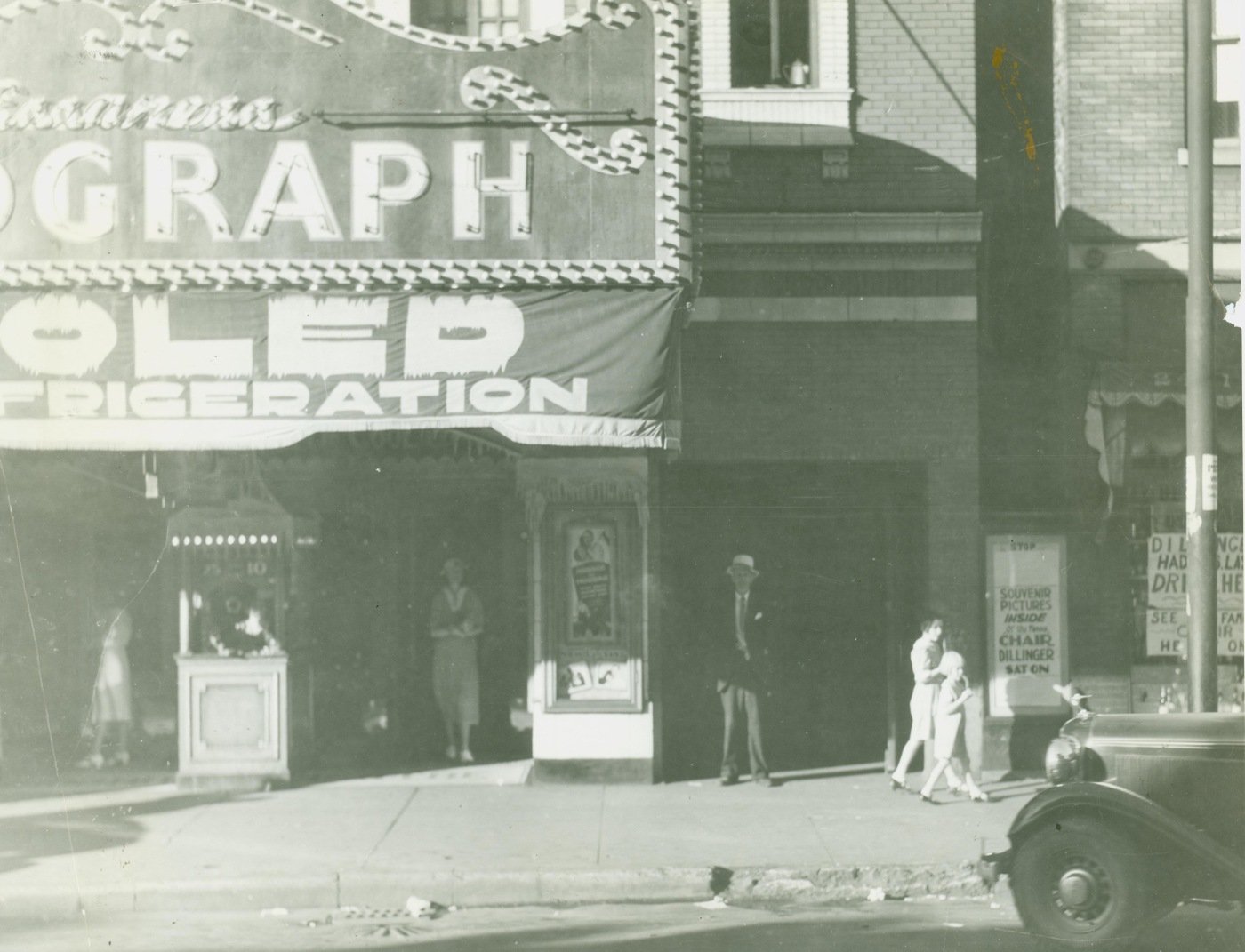
The Biograph Theater
Source: https://www.fbi.gov/history/famous-cases/john-dillinger
0 Response to "Shoots Burglar 5 Years Ago and Again Recently"
Post a Comment